As every year, the General State Budget Law updates the Social Security contribution bases.
General Scheme: For 2014, the minimum contribution base has been frozen (in the same way as the national minimum wage), remaining at €753 per month; while the maximum base has increased by 5%, rising to €3,597 per month. From January 1, 2014, the contribution bases to the General Scheme of Social Security for common contingencies will fall within the following minimum and maximum limits for each contribution group:
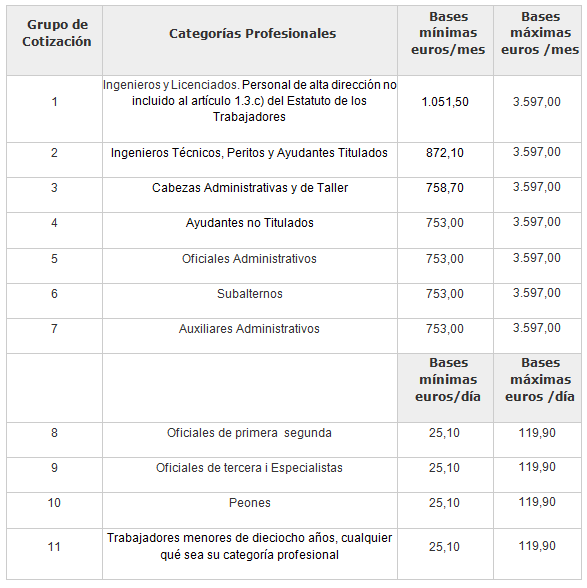
It should be noted that, in addition to the usual updating of the amounts, this year significant changes have been introduced by Royal Decree-Law 16/2013, of December 20 (in force since 21/12/2013), which modifies article 109 of the General Social Security Law that establishes the concepts computable in the contribution base to the general scheme, establishing the inclusion of the following concepts previously excluded:
- All in-kind benefits.
- The total amount of transport and distance allowances.
- All improvements to Social Security benefits, except for the Temporary Disability (TD) supplement.
- Welfare allowances, except those corresponding to expenses for the worker's studies when required by the development of their activities or the characteristics of their job.
- All living and accommodation expenses incurred in the same municipality as the worker's usual place of work and where they reside.
The aforementioned amendment means that certain financial benefits paid to employees that were previously exempt from social security contributions, either partially or entirely, will now be subject to contributions. Of particular note are those in-kind benefits that, until December 21, 2013, were excluded from the contribution base, such as meal vouchers, childcare vouchers, etc., as well as the payment of health insurance premiums, contributions to pension plans, and the distribution of company shares or stock, either free of charge or at a reduced price.
Since the aforementioned Royal Decree-Law came into force on 22/12/2013, the General Treasury of Social Security interprets that it is already applicable to the salary and contribution settlements for the monthly period of December 2013 and grants a deadline until 31/03/2014 to submit the corresponding supplementary settlement for these concepts.
Furthermore, as a control measure, Royal Decree-Law 16/2013 also introduces a new obligation for companies: to report to the General Treasury of the Social Security the amount of all remuneration paid to their employees for each settlement period, regardless of whether or not it is included in the contribution base and even if a single contribution base applies. Compliance with this new obligation must be carried out by electronically submitting a file through the *RED system, called “remuneration items paid,” which must be submitted monthly.
- Special Scheme for Self-Employed Workers (RETA): For the year 2014, the minimum contribution base to the RETA is increased by 2%, while the maximum is increased by 5% (the same as the maximum of the general scheme), becoming the following amounts:
- Minimum base………………… 875.70 euros per month
- Maximum base……………….. 3,597.00 euros per month
However, Royal Decree-Law 16/2013 (Additional Provision 2) introduces a modification to the contribution system for self-employed workers who, in each fiscal year, have employed 10 or more employees, as well as for self-employed business owners (directors and/or working partners of companies over which they have effective control). For both groups of self-employed workers, the minimum contribution base will not be €875.70 per month, but rather the same amount as that corresponding to workers classified in contribution group 1 of the general Social Security scheme, that is: €1,051.50 per month. This change represents an increase of 52.57 euros to the fee they will have to pay each month (314.40 euros), compared to what they would have to pay if this change had not been made (261.83 euros), which will not apply to new self-employed business owners who register initially with RINDA during the first 12 months of their activity, counting from the effective date of said registration.
Reform of the labor reform
Otherwise, Royal Decree-Law 16/2013 also modifies the Workers' Statute –which was already reformed first by Royal Decree-Law 3/2012, of February 10; and subsequently by Law 3/2012, of July 6– which, among other changes, includes the following:
– It prohibits overtime work for part-time employees (returning to the situation prior to the Labor Reform…) and limits the possibility of agreeing to additional hours in part-time contracts with a minimum weekly working day of 10 hours.
– The right to reduced working hours for legal care of children is extended to the age of 12 (instead of 8 years as before…).
– The employer's contribution for unemployment insurance for part-time temporary contracts is equated to that of full-time temporary contracts.
– The irregular distribution of working time is encouraged by allowing the regulation of excesses or deficits in working hours beyond the calendar year.
– The possibility of agreeing to the new contract for supporting entrepreneurs is extended to also be part-time, with a trial period of one year and enjoying the tax incentives and Social Security bonuses in proportion to the contracted working hours (until now it could only be celebrated on a full-time basis).
– The trial period for temporary contracts is limited to a maximum of one month for those contracts with a duration of no more than six months.
– Temporary employment agencies are authorized to hire trainees to be made available to user companies.
– Point 8 of Article 33 of the Workers' Statute, which stipulated that for open-ended contracts entered into by companies with fewer than 25 employees, when terminated due to collective dismissal, objective dismissal, or dismissal in companies in insolvency proceedings, the Wage Guarantee Fund would pay a portion of the severance pay equivalent to 8 days' wages per year of service, is eliminated. Therefore, as of January 1, 2014, companies with fewer than 25 employees will also have to pay the full severance pay for objective dismissals of 20 days' wages per year of service.
Do you have any questions about this topic?
Our team of expert advisors will help you resolve any issues related to our services.
Contact us now
A Àmbit Assessor, SL has 40 years dedicated to the tax, comptable and labor consultancy of the Pime.
Latest entries from MGI Àmbit
(see all)
Related