
The regulatory landscape for housing has changed again in a matter of days. Royal Decree-Laws 26/2026 and 27/2026 were repealed on October 2nd, and now the Official State Gazette (BOE) has published two new regulations that reinstate many of those measures. For landlords, tenants, investors, and companies linked to the sector, it is especially important to distinguish what remains in place, what has been modified, and when it will take effect. It is now up to the Standing Committee of the Congress to assume the powers constitutionally granted to it during this period. Therefore, it will be necessary to closely monitor the ratification of both texts.
The Official State Gazette (BOE) of October 7, 2026 publishes two new regulations that once again place housing, rentals and their taxation at the center of current legislation.
This refers to Royal Decree-Law 28/2026, of October 6, on the stability of residential lease agreements, and Royal Decree-Law 29/2026, also of October 6, which brings together a much broader package of measures on tenant protection, taxation, affordable housing, financing and residential supply.
The publication comes just days after an unusual event. Royal Decree-Laws 26/2026 and 27/2026, approved on September 29, were repealed by agreement of the Congress of Deputies on October 2.
The new texts reinstate a significant portion of those measures, although not in an entirely identical form. There are adjustments to their temporal scope, some transitional rules, and certain aspects of their practical application.
For this reason, those who have already analyzed the previous decrees should not simply reiterate their conclusions. It is advisable to review each scenario again.
A particularly turbulent regulatory calendar
The first thing to understand is the sequence of dates. Royal Decree-Law 26/2026 was published on September 30 and came into effect on October 1. Royal Decree-Law 27/2026 was published on October 1 and entered into force the following day. On October 2, Congress agreed to repeal both texts. Five days later, the Official State Gazette (BOE) published their replacements.
- The new Royal Decree-Law 29/2026 comes into force, in general, on October 8, 2026. Some of its provisions, especially those related to taxation, have specific application dates.
- Royal Decree-Law 28/2026 follows a different timetable. Its entry into force is expressly delayed until November 15, 2026.
Rentals for primary residences are gaining stability
Royal Decree-Law 28/2026 modifies again article 10 of the Urban Leases Law (LAU).
Once the minimum contract duration has expired, five years when the owner is a natural person and seven when the owner is a legal person, the continuity of the lease takes on a much more relevant position.
If neither party validly communicates its intention to terminate the contract, it may continue for successive periods of five or seven years, as appropriate.
The notice period for landlords seeking to prevent continued tenancy is also extended. The landlord's notice period is now generally six months, while the tenant's remains at two months.
However, in certain contracts nearing expiration, a transitional rule is contemplated that allows the four-month notice period to be maintained.
The new rule also introduces economic consequences when it is the landlord who decides not to continue the contract in the cases provided for by law.
When compensation is due, the higher amount between twelve monthly payments and one monthly payment for each year of the tenant's residence shall be considered.
Not every lease termination will generate this compensation. The law includes exceptions, among them certain situations where the landlord or their family members are in need of housing, the tenant's lack of a permanent residence, the availability of other suitable housing, or certain cases where an alternative contract has been offered.
- Important. Before sending a non-renewal notice, it is highly advisable to verify the exact contract signing date, any previous extensions, the current expiration date, and the date on which the decision will be notified. A notice that was formally correct under the previous regulations may not be so under the new ones.
The new Royal Decree-Law 28/2026 also introduces a significant clarification compared to the repealed text. Notifications of non-renewal validly submitted before the publication of the new decree remain effective and do not generate the new compensation payment. The regulation also expressly addresses what happens to contracts that were already under tacit renewal and those within a previous extension period.
An extraordinary extension of up to two years
Royal Decree-Law 29/2026 reinstates the possibility for certain tenants to request an extraordinary extension of their lease. This measure affects, among other cases, leases for primary residences whose mandatory extension period ends before December 31, 2028. The extension can be granted in annual increments, up to a maximum of two additional years.
It is not granted automatically. The tenant must apply for it and be up-to-date on rent payments. Furthermore, they must have fulfilled their monthly obligations for the previous eight months.
Coordination with the new ordinary extensions of Royal Decree-Law 28/2026 prevents both mechanisms from accumulating indiscriminately.
- Attention. When a contract is nearing its expiration date, it is not enough to simply check its start date. You must determine which contractual period it is in and whether the ordinary extension, the extraordinary extension, or a transitional rule applies first.
Extraordinary limit for certain rent updates
Another measure being reinstated is the time limit on certain rent increases. Until December 31, 2027, rents that already exceed the maximum limit established by the reference index system cannot be increased.
In all other cases, the agreement reached by the parties may be applied, and when there is no new agreement, the increase may not exceed 2%.
At the same time, the Reference Index for the Annual Update of Housing Lease Agreements, known as IRAV, is consolidated as the maximum reference for certain updates.
Temporary rentals are much more clearly defined
One of the areas undergoing the most significant changes is seasonal rentals. The regulation does not simply use that term. It requires a genuine, identifiable, and verifiable reason for the temporary nature of the rental.
This could be, for example, a temporary move from one's usual residence for professional, academic or similar reasons, but the cause must actually exist.
The duration must exceed thirty-one days and, as a general rule, may not exceed twelve months. If the cause persists, the duration may be extended under the legally prescribed conditions.
When there is insufficient justification, the time limit is exceeded without a proven reason, or certain chains of contracts occur between the same parties, the lease may be considered a habitual residence.
The rule aims to prevent temporary contracts from being used simply as a way to circumvent the protective regulations for residential leases.
- Attention. Simply stating in the heading of a document that it is a "seasonal contract" is no longer sufficient. The temporary nature of the contract must be described and documented.
Room rentals are also subject to limits
The reform expressly incorporates the partial rental of a dwelling into the Urban Leasing Law (LAU). The classification will depend on the need being met. A room rental may be for a permanent or temporary rental.
Furthermore, a particularly relevant limitation is introduced for those who rent out the same dwelling in separate rooms. The sum of the rents charged for the rooms cannot be used to exceed the limits that would result from renting the entire dwelling as a single unit in the cases provided for by law.
New obligations for owners and intermediaries
The reform also expands tenant protections. Among other things, it strengthens the limitations on passing on certain real estate management and contract formalization costs to the tenant.
Rules are also developed regarding repairs, additional guarantees, written documentation and proof of the state of conservation of the dwelling.
Rental advertisements will have to include certain information where applicable, especially in areas with a tight housing market. Among other details, it may be necessary to identify the reference index, the legal rent limit, and whether the landlord is a large property owner.
- Attention. Real estate agencies, property managers, and owners who market their properties directly should adapt their advertising templates and contract documentation.
Greater protection in case of sale of the property
The new regulations also extend tenant protections when a rented dwelling is transferred along with other assets or real estate. If the dwelling is legally identifiable, the new rules for determining the transfer value and exercising the corresponding right of first refusal must be respected.
Furthermore, the possibility of anticipating the tenant's waiver of certain rights of first refusal and redemption is limited.
- Attention. In transactions involving the sale of buildings, asset lots, or real estate portfolios with leased properties, it is advisable to review each contract individually before formalizing the transfer.
Suspension of certain evictions until 2030
Certain protection measures for vulnerable people without alternative housing are reinstated and extended. In certain circumstances, the suspension may last until December 31, 2030.
The specific application depends on who initiates the procedure, the situation of vulnerability, and the actions of the competent Administration.
A particularly intensive administrative intervention is also introduced in some non-payment processes.
When vulnerability is proven, the Administration may have a period of two months to provide an alternative housing or to cover the necessary amounts under the terms provided for in the regulation.
If that period elapses without a housing solution or payment or deposit, the Administration itself may be subrogated to the debtor's position as long as the legal circumstances remain.
- Attention. Landlords currently processing eviction proceedings should immediately check if the new transitional rules affect an eviction already scheduled.
Much broader tax incentives for homeowners
One of the most important sections concerns personal income tax (IRPF). The law establishes a new system of reductions on the net positive income obtained from renting out properties. There is no longer a single percentage that can be applied automatically.
The reductions will depend on factors such as the evolution of the rent compared to the previous contract, the tenant's continued tenancy, the location of the property in a high-demand area, the tenant's age, the affordability of the rent, participation in certain public programs, or the completion of renovation work. In some cases, the reduction can reach 100%.
There are also intermediate percentages of 95%, 90%, 85%, 80%, 70%, 60%, 50%, 40%, 30%, 25%, 20% or 15%, depending on the specific situation.
The range of cases is therefore considerably greater than before.
- Attention. Two landlords with similar properties may end up applying very different tax reductions. It will be necessary to keep previous contracts, rental documentation, the tenant's move-in date, and, where applicable, documentation related to rehabilitation, age, or public programs.
State deduction returns for certain tenants
Taxpayers with a taxable income below €33,007.20 may be eligible for a state deduction equivalent to 10% of the rent paid for their primary residence, provided they meet the requirements. The maximum deduction is €11,630 when the taxable income does not exceed €23,007.20. From that amount up to the limit of €33,007.20, the deduction is progressively reduced.
The measure must be coordinated with the regional tax deductions that each taxpayer may apply.
Exemption from certain gains when transferring housing to the public sector
The reform introduces a tax advantage for certain transfers of homes to public entities dedicated to promoting or managing social and affordable housing.
When the legal conditions are met, certain capital gains may be exempt until December 31, 2027.
The system provides for a total exemption up to certain amounts and a decreasing application as the transfer value increases.
The requirements include certain economic limits and circumstances related to the previous vacancy of the property.
The Financia Europa Savings and Investment Account is launched
The reform is not limited to housing. Royal Decree-Law 29/2026 also creates the so-called Financia Europa Savings and Investment Account. This scheme allows for the deferral of taxation on gains and losses obtained from certain assets until they are disposed of under the terms stipulated in the legislation.
For gains attributable to contributions held for more than five years, a 100% tax exclusion is contemplated up to a combined maximum of 10,000 euros per taxpayer and 20% for certain remaining amounts.
The contributions pending recovery are also subject to limits.
New Individual Long-Term Savings Insurance Financing Europe
A specific type of insurance called SIALPFE is also being created. Its contribution limit reaches €10,000 per year, compared to the €5,000 limit established for other long-term savings plans. The tax advantage requires compliance with a minimum holding period and other legally established conditions.
Certain short-term rentals will now be subject to a 10% VAT rate
From December 1, 2026, certain rentals of furnished apartments and homes will no longer be exempt from VAT. The measure affects certain short-term rentals and those that include services typical of the hotel industry. The applicable rate will be 10% in the regulated cases.
This does not mean, however, that all seasonal rentals will be subject to VAT from December onwards. The specific circumstances depend on the characteristics of the transaction.
Reduced VAT for certain home renovations intended for rental properties
The reduced rate also applies to certain renovation and repair work carried out on homes intended for primary rental. Among other conditions, a minimum age for the property is required, and the weight of the materials supplied is limited within the total cost of the project.
Changes to the IBI
Municipalities located in areas with a tight residential market may introduce, through their tax ordinances, specific surcharges on certain properties. Tourist accommodations may be subject to a surcharge of up to 50% of the net tax due.
That percentage can reach 100% in certain owners with two or more homes intended for tourist use and 150% when it involves four or more.
The reform also regulates again surcharges applicable to certain unoccupied residential properties.
New treatment of certain SOCIMI benefits
The reform also modifies the taxation of SOCIMIs (Spanish REITs). In general, a special 15% tax is established on certain undistributed profits from the fiscal year that originate from income not taxed at the general rate or included in the corresponding reinvestment regime.
When those undistributed profits come from residential leasing, tourist accommodation, lodging or short-term rentals included by the rule, the special tax will be 25%.
This latter percentage can be reduced in certain cases when a very significant part of the housing stock is allocated to affordable rental and can be neutralized in the cases of reinvestment provided for by law.
New coefficients for municipal capital gains tax
The maximum coefficients that can be applied to calculate the taxable base of the Tax on the Increase in Value of Urban Land (Municipal Capital Gains Tax) are also modified. The scale depends on the period in which the capital gain was generated, from transfers made less than a year ago to those made twenty years or more ago.
Financial support to access first home
Another key measure is the mechanism called YOUR HOME. It is designed as supplementary financing for those buying their first primary residence with a mortgage.
The loan may cover the lesser of 20% of the property value and 50,000 euros.
The regulation stipulates a zero percent interest rate and no fees, although many of the specific conditions will need to be developed through an agreement by the Council of Ministers. Its management will be the responsibility of the ICO (Official Credit Institute).
- Please note: The publication of the decree does not mean that applications can be submitted immediately. It will be necessary to wait for the operational development of the line and the approved conditions.
More resources for affordable housing
The package also includes measures aimed at increasing the stock of affordable housing. It regulates contributions of public properties to CASA 47 and establishes a Social Impact Housing Fund.
Guarantees of up to 2 billion euros are also planned for certain social or affordable housing promotion projects, and an additional line of up to 280 million euros for projects linked to industrialized construction.
The regulation itself also establishes an economic definition of affordable housing linked to the effort of the cohabitation unit with respect to the municipal median income.
What has changed with respect to the repealed decrees?
The comparison is important because the new texts do not simply change the number of the Royal Decree-Law.
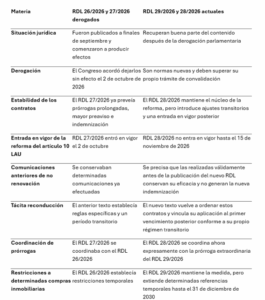
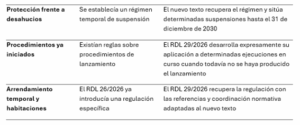
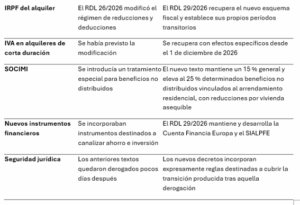
The new texts, therefore, should not be presented simply as a "replacement" of the previous ones.
Most of the design remains the same, but some dates and transition rules have changed. The clearest example is Royal Decree-Law 28/2026. While the previous Royal Decree-Law 27/2026 came into force the day after its publication, the new regime on contractual stability will not begin to apply until November 15, 2026.
The horizon of certain restrictions and protection measures contained in Royal Decree-Law 29/2026 is also extended until December 31, 2030.
One last point that should not be forgotten
The new royal decree-laws are in force from the dates established in each of them, but their continuity is not definitively assured by the mere fact of having been published in the BOE.
The Constitution requires that royal decree-laws be submitted to parliamentary validation.
Following the dissolution of the Chambers and the calling of elections, it is up to the Permanent Deputation to assume the powers provided for constitutionally during this period.
Therefore, we will have to pay attention to the validation of both texts.
Therefore, we recommend individually analyzing decisions that cannot be reversed, especially renewals or terminations of leases, real estate transactions, temporary contracts, rent modifications, and tax actions linked to the new benefits.
Our office will continue to provide information on the processing of these regulations and on any interpretative criteria or regulatory developments that may affect their application.
You can contact this professional office for any questions or clarifications you may have.
Warm regards,
Do you have any questions about this topic?
Our team of expert advisors will help you resolve any issues related to our services.
Contact us now
A Àmbit Assessor, SL has 40 years dedicated to the tax, comptable and labor consultancy of the Pime.
Latest entries from MGI Àmbit
(see all)
Related